
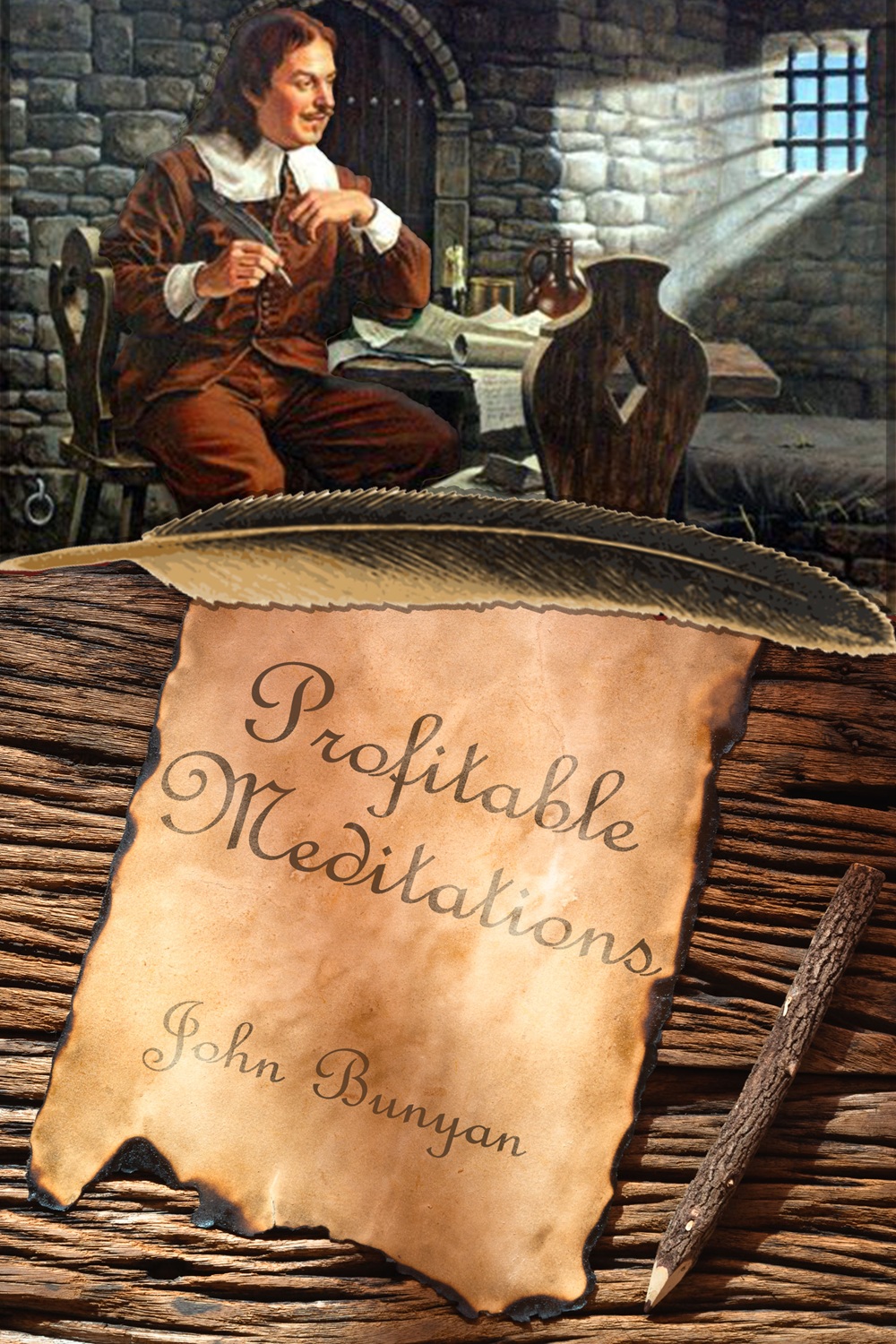
Profitable Meditations
Fitted to Man’s Different Condition: in a Conference Between Christ and a Sinner. In Nine Particulars.
By John Bunyan, servant to the Lord Jesus.
London: Printed for Francis Smith,[1] at the sign of the Elephant and Castle, without Temple Bar. 1881.
ADVERTISEMENT BY THE EDITOR.
THE lovers of Bunyan and the Christian public are indebted to Mr. Hotten, the active, intelligent bookseller of Piccadilly, for• the discovery of these interesting poems, in a small quarto volume of tracts; and for a very faithful reprint of them, at the elegant Chiswick press of Messrs. Whittingham & Wilkins.
This pious tract is written without the least attempt at display, unless it be to show the author’s decided attachment to the simple but sublime truths of the gospel. It was published while he was a prisoner, for conscience sake, in a gloomy jail. The laws of his country forbade him to invite his neighbours to meet together to extol the Saviour, and to proclaim the great grace which had been bestowed upon one who was well known to have been a Jerusalem sinner. His earnest desire was to have made known to others the Saviour who had converted him from being a pest to society, and had fixed his goings in the ways of holiness and peace. He was forbidden to preach, but his sense of duty impelled him at all hazards to refuse obedience to such a restriction. The result was, as he had anticipated, that he was separated from his family and incarcerated in Bedford jail. Mr. Howard, the philanthropist, who visited this prison, states that the daily allowance to each prisoner was water, half a quartern loaf, and coals in winter; a starving pittance to a hearty man with a wife and four young children. But was this pious man bound to disobey this law and thus to suffer? This is a most important and interesting inquiry. It was so with Daniel and the three Hebrew youths. They refused obedience to laws which interfered with divine worship, and it rendered them liable to the most cruel torments. But God saved and abundantly honoured them in their imminent peril. They honoured God by refusing obedience to commands which interfered with their freedom of approach to the mercy-seat; and God honoured them by overruling their punishment, to make it a splendid and lasting triumphant memorial, handing their names down to the end of time as men whom the Lord delighteth to honour.
God, who alone ruleth over spiritual worship, has drawn a clear line to distinguish fealty to the supreme and to a temporal governor. ‘Render unto Caesar the things which are Caesar’s, and unto God the things that are God’s.’ Spiritual worship in all its forms belongs exclusively unto God, and to Bunyan’s mind, all human punishments for the strictest obedience to the divine law were of less weight than the bubble vanity or worldly favour, or cruel sufferings, even unto death. He met his little flock, when, as he narrates, ‘the devil, that old enemy of man’s salvation, took his opportunity to inflame the hearts of his vassals against me, and I was taken by a warrant and committed to prison.’ There he remained for more than twelve years.
His great object while a prisoner was to bring forth fruit to the glory of divine grace. To provide for his family a humble dwelling and the coarsest food, he felt to be his first duty, and it excited his utmost efforts. His first attempt was by tagging laces, made by his children, and sold by them to numerous friends who had been blessed by his ministry. This was aided by writing and publishing poems and tracts, of which these PROFITABLE MEDITATIONS were very probably the first. His religious views were rivetted in his mind by deep and hallowed experience; they changed not, but appear in these humble effusions, as in all his writings. The means used by his enemies, armed with arbitrary power, to prevent his usefulness, vastly extended it. Many who would not or could not have attended his ministry, read these noiseless messengers of glad tidings in private, the profits from the sale of which assisted to clothe and feed his family. Thus was his invaluable life preserved to write those important legacies to the church-GRACE ABOUNDING TO THE CHIEF OF SINNERS, which he wrote to his friends, while I stick between the teeth of the lions in the wilderness,’ and the PILGRIM’S PROGRESS, both of which shone forth from the prison, his den, with a radiance that at length has extended to the uttermost ends of the earth, to comfort the heaven-ward pilgrims to the Celestial City. Never was the glorious prophecy of Asaph[2] more manifest : ‘Surely the wrath of man shall praise thee; the remainder of wrath shalt thou restrain.’
These homely rhymes cannot be recommended better than in the language of their author:
‘Take none offence, friend, at my method here,
’Cause thou in verses simple truth dost see,
But to them soberly incline thine ear,
And with THE TRUTH ITSELF affected be.’
Bunyan’s views of that most important of all facts, SALVATION FROM SIN, were drawn undefiled from the holy oracles, without the advantages or the pollutions of human learning or educational tradition. Careless of style or rhetorical effect, all his object was to draw the sinner from the downward road to perdition by solemn warnings, pointing out his danger, and directing him to the fountain of salvation, flowing all free and plenteous from the work and sufferings of the Saviour.
Profitable Meditations
THE CONTENTS.
There is in this small Piece these following things discoursed.
- Of Man by Nature.
- Of the Sufferings of Christ.
- Of the Saints or Church.
- A Discourse between Satan and a tempted Soul.
- A Discourse between Christ and a Sinner.
- A Discourse between Christ and a doubting Soul.
- A Discourse between Death and a Sinner.
- A Discourse between Death and a Saint.
- A Discourse of the Day of Judgment, both with the Godly and Ungodly.
TO THE READER.
Take none offence, friend, at my method here,[3]
’Cause thou in verses simple truth dost see:
But to them soberly incline thine ear,
And with the truth itself affected be.
’Tis not the method, but the truth alone
Should please a saint, and mollify his heart:
Truth in or out of metre is but one;
And this thou know’st if thou a Christian art
You also that content yourselves to see
Man’s wit in verses, and no further look:
You will not by them edified be:
You see only the back side of the book.
Man’s heart is apt in metre to delight,
Also in that to bear away[4] the more:
This is the cause I here in verses write,
Therefore affect[5] this book, and read it o’er.
When doctors give their physic to the sick,
They make it pleasing with some other thing:
Truth also by this means is very quick,
When men by faith it in their hearts do sing.
I am thine in Christ,
JOHN BUNYAN of Bedford.
[A Brazier, now in prison in Bedford, 1664.][6]
I. OF MAN BY NATURE.
- That man is blind that doth not plainly see
The woe that sin doth bring upon the soul.[7]
And yet thus blind the most of sinners be,[8]
The case is plain, their hearts for Heav’n are cool.
- For I see plainly, if man did but know
What wrath and vengeance hangeth o’er his head;[9]
He then would fly from sin, his mortal foe,[10]
Rather than have his part among the dead.
- But here, alas! the devil with his wit
Doth out-go sinners, to their mortal woe,[11]
And with his snares he doth so catch their feet,[12]
That they with joy unto his place do go.
- ’Tis marvellous to see that man so wise[13]
And noble by creation, as is he,[14]
Should in this manner let sin blind his eyes,
That neither heaven nor hell he well can see.[15]
- But like one blind, or mad, or worse, he runs[16]
At Satan’s beck, to his perpetual shame[17]
Till into ruin headlong down he comes,[18]
Into the fearful fire and endless flame.
- When man doth study of things here below,[19]
What pretty arts will he invent in time?[20]
He’ll find out much, and do it neatly too;[21]
But yet he doth not see the gospel shine.
- Oh! ’tis a shame for thee, who know’st so much[22]
Of God, by creatures, Scriptures, mercies great:[23]
To let thy conversation be such,[24]
That God must with his stripes thee soundly beat.
- The ox is wiser in his kind than thee,
For he doth make his master’s crib his choice;[25]
Condemned by him therefore thou may’st be,
For he, not thee, obeys his master’s voice.[26]
- But what’s the reason man should be so vain,
To disregard himself and glory so?
The reason is, he doth not feel the pain,
That for his sins he shortly must come to.[27]
- He doth not really believe the word
That God hath spoken against sinful men,[28]
For if he did, ‘twould pierce him like a sword,[29]
’Tis Christ in whom he would seek to stand then.[30]
- Also he of his soul knows not the worth;[31]
For if be did, he would be wiser than
To sell it: but to Christ he would come forth,[32]
And close with him that proffers grace to men.[33]
- Awake therefore, thou fool, and lay to heart[34]
Thy latter end, and stir thee timely too:[35]
Get heav’n, and thou wilt play a wise man’s part,
Or else not I, but thou shalt feel the woe.
II. OF THE SUFFERINGS OF CHRIST. ,
- The God of grace beholding man so vile,[36]
To tumble in his gore and wicked vice:
Did yet vouchsafe upon poor man to smile,
And buy him to himself with heavenly price.[37]
- ’Tis wonderful to think that God on high,[38]
Should set on man so much his heav’nly love:[39]
That for him he should give his Christ to die,
To bring his soul from hell to heaven above.
- When man had made of sin an heap so great[40]
And weighty, that it made the world to quake:[41]
God did his son Christ with this burden break,[42]
Which made his very soul and body shake.
- For why, the weight of sin which he did bear,[43]
What time he in our stead stood before God:[44]
It did his precious soul and body tear,
Because his Father scourg’d him with his rod.
- The wicked sinn’d, the just did bear the blame,[45]
Here is the myst’ry of the gospel—love:[46]
That Christ for us should bear the cursed shame[47]
And wrath (that we deserved) from above.
- The pains he bore were more than we can think,[48]
Which by his bloody sweat and wounds we see:[49]
For he the cup of God’s wrath up did drink,[50]
That he us bondslaves by it might set free.
- It’s plain enough, for though he was most strong,[51]
So that he could the world make and uphold:[52]
Yet did our sins this blessed Christ so wrong,
That he to death for them some time was sold.
- The rocks did rend, the earth did shake full sore,[53]
The sun that shone was all amaz’d to see[54]
The Son of God upon the cross to roar;[55]
Which clearly speaks his grief full sad to be.
- Besides, his Father from him hid his face,[56]
Which most of all did wound his tender heart,[57]
Thus was our Christ in miserable case,
When he for our accursed sins did smart.
- Sweet Jesus, though our sins to us be light,
That we can carry them with pleasure, yet[58]
They made thee groan, and did thee sorely fright,[59]
Before the spear with thy heart blood was wet.[60]
- Thy sorrows were as great, as great could be,[61]
For all were set against thee for our sin:[62]
Both heav’n and hell, death, and the devil, he
Left no means unassay’d thy soul to win.[63]
Thou did’st triumphantly o’ercome them all:[66]
Though in thy work thou had’st a bloody sweat,
Yet thereby we are kept from fatal fall.[67]
- Now heaven and earth, yea death and hell, are thine,[68]
To do with them, as thou most wise seest best:[69]
And thou hast promis’d glory shall be mine,[70]
And all things here shall for thy sake be blest.[71]
- Why should I then fear sin, or death, or hell,[72]
Or wrath, or devil, with his fiery darts?
Let them fear these who for sin, Christ do sell.[73]
And care not for his blood to cleanse their hearts.
III. OF THE SAINTS, OR CHURCH.
- By this means is the sinner made a saint,[74]
And brought from under every curse of God:[75]
Which is the cause his sinful soul don’t faint,
Though he do feel his Father’s scourging rod.
- Here now with joy I can behold God’s face,[76]
Though I am vile, and base as base may be:[77]
I am encourag’d in the heav’nly race,[78]
Because Christ died, and spilt his blood for me.
- If Satan speak of sin, then here’s Christ’s grace;[79]
If death, or hell, or law doth me assail,[80]
Then to my JESUS I do run apace;
For he’s a Friend that never doth me fail.[81]
- He is become my righteousness and life,[82]
His blood was shed to make me white as snow,[83]
By this means also I am made his wife:[84]
Who then dare hurt me, or become my foe?
- And this is not against his Father’s will,[85]
But his consent in this doth also run;[86]
Therefore of joy I now may take my fill,[87]
For it hath pleas’d him that this should be done.
- But am not I in case most excellent,[88]
Who have this blessed peace in Christ my Lord?[89]
His tender love on me is so much bent,
That he to me will heav’n and life afford.[90]
- O Lord, I never thought on this rich grace[91]
When I in wickedness did spend my time;[92]
For then I was still running from thy face,[93]
And thought not on my own good, much less thine.
- But now when I so little did regard,[94]
To fear thy name, and ask thee for thy love,[95]
Thou might’st for sin have giv’n me that reward,[96]
As ne’er to let me come to heaven above.
- But though so gracious thou hast been to me,[97]
It is not for my righteousness so good,[98]
But for the love thy Father bears to thee,[99]
That I am washed in thy precious blood.
- I of myself am vile as other men,[100]
Like unto them in heart, and word, and life;[101]
It must be grace that justifies me then,[102]
And sets me blameless in thy heav’nly sight.
- Seeing ’tis thus, Lord, let my soul enjoy[103]
Thy blessed Spirit of grace, and faith, and love:[104]
O let me not thy heav’nly ways annoy,[105]
But take my heart from earth to heav’n above.[106]
- Thus am I fair, though also very black;[107]
Fair in my Christ, though black in nature’s deed;[108]
And I, though vile, no righteousness do lack,[109]
For Christ is mine, to help me at my need.
- Now then, if Jesus Christ stands, so shall I;[110]
For he is my completeness all the day:[111]
I’ll look no further, here I’ll live and die,[112]
Come death or judgment, CHRIST will ne’er decay.
- Though many times I cause my Christ to hide[113]
His face; yet he’ll not leave me in my doubt,[114]
But still my Help and Friend he will abide,[115]
And when I’m lost, he’ll seek and find me out.
- This is the state of saints, both weak and strong;[116]
They have this help, this profit, and this stay:
For Christ doth walk his candlesticks among,[117]
To keep his weak ones, lest they pine away.
- Hold up thy head, therefore, thou doubting saint,[118]
Thy tender-hearted Christ is very sweet;[119]
His loving-kindness will not let thee faint:[120]
Look else upon his side, his hands, and feet.
IV. A DISCOURSE BETWEEN SATAN AND THE TEMPTED SOUL[121]
- Satan.—Thou wretch, how dar’st thou once lift up thy head?[122]
Look to thy life that’s past, and blush for shame:
You may presume, but yet your heart is dead,[123]
And may beguile yourself with Christ his name.
- Soul—I know I am as base as base may be,[124]
My sins are mighty, and my heart is hard;[125]
But yet my Jesus saith he will save me,[126]
And therefore I will not thy rage regard.
He is so holy, and they are so bad:[129]
’Tis but in vain that thou to him should’st pray;
Believe me, there’s no mercy to be had.
- Soul.—The Scripture saith Christ bled for sinners great,[130]
To save them from their sins, the law, and hell,[131]
His flesh and blood by faith I’ll drink and eat,[132]
And trust by mercy yet I shall do well.
- Sat.—Thou painted hypocrite, how dar’st thou think[133]
Of mercy? don’t thy heart thy mouth condemn?[134]
Thou may’st at sin now, like a rebel, wink;[135]
But death is coming, what wilt thou do then?
- Soul.—God knows my sins have reached unto the cloud.[136]
Sins of all sorts, as thou dost truly say;[137]
But since the blood of Christ doth cry so loud,[138]
I fear not but they shall be done away.
- Sat.—But where’s thine evidence for heav’n? thou fool![139]
How can’st thou tell the work of grace is true?[140]
Was’t ever taught by God in Christ his school?[141]
If not, for all thy brags thy soul must rue.
- Soul—I have been made to see my sins most vile,[142]
And to abhor them also with mine heart;[143]
And this frame I was in a pretty while,[144]
And for them God bath made me soundly smart.
- Sat.—If this be all, then hear me what I say,[145]
Thou yet art short of feeling saving grace;[146]
For thus were Cain and Judas in their day,[147]
And yet, thou know’st, were banish’d from his face.
- Soul—But I have tasted of his heav’nly love,[148]
Which he hath shed abroad within my heart;[149]
And he hath said to me I am his dove,[150] [151]
And this hath rid me of my guilt and smart.[152]
- Sat.—But yet you know that men may taste of this,[153]
So as to wonder at the blessedness;[154]
How know you, therefore, but yet you may miss,[155]
And undergo God’s justice nevertheless?
- Soul.—God hath confirm’d me more than once or twice[156]
By several blessed promises of his,[157]
And warm’d my heart when ‘twas as cold as ice;[158]
Therefore I hope I shall enjoy his bliss.
And knowingly sinn’d against the Lord of hosts?[161]
If so, for all you are at such a height,[162]
You may have sinn’d against the Holy Ghost.
- Soul—Now Satan you have touched me at the quick,[163]
For many sins I sin against my light;[164]
But yet this don’t my spirit greatly prick,[165]
For Christ his blood is still within my sight.[166]
- Sat.—Though Christ his blood was shed for sinners great,[167]
Yet, seeing thou has sinn’d as thou hast said,[168]
Thou must not dare of Christ his flesh to eat,[169]
’Tis not for thee; thou well may’st be afraid.
- Soul.—If all that sinn’d against their light did sin[170]
Against the Holy Ghost, as thou dost say,
What case was Peter then and David in,[171]
For, by your saying, they were cast away?
- Sat.—But God chose them before the world began,[172]
And so thou can’st not say he hath done thee;[173]
And therefore it is but a folly, man,
To strive against the stream—you’re gone, you see.
- Soul.—These men committed sin as well as I;[174]
Why, therefore, should I be discourag’d so?
I’ll flee to Jesus Christ, I can but die:[175]
That grace that saved them will save me too.[176]
- Sat.—But they had heav’nly pardon from their God,[177]
And that, too, after they had sinn’d so sore,[178]
And so were saved, though they were so bad;[179]
But thou, poor simple wretch, art in thy gore.
- Soul.—I bless the name of Christ, my dearest Lord;[180]
For all I have thus sinned in his sight,[181]
He doth his comforts still to me afford,[182]
And pardoneth my sins against my light.
64.[183] Sat.—But how can you tell that your comfort comes[184]
From God? for I can mock you with a word:[185]
And yet you shall not get so much as crumbs
From Christ, to feed you underneath his board.
- Soul,—Thou art indeed a cunning devil, yet[186]
Thou shalt not beat me from my steadfast faith;[187]
For Christ into his heart will let me get,[188]
So can I tell thee what my Jesus saith.
- Sat.—Your faith is fancy, like the spider’s web;[189]
You cheat yourself in saying you have grace.[190]
Come down to hell, man, for there is your ebb,[191]
And give way to despair,[192] for there’s your case.
- Soul.—Methinks I see my loving Jesus smile;[193]
He shows me now his blessed hands and feet,[194]
And gives me comfort with his word so mile;[195] [196]
The bitter’s thine, but I must have the Sweet.
- Sat.—How dost thou know thou shalt hold out to th’ last?[197]
Thine heart is weak, and that thou know’st full well.[198]
I’ll follow thee with many [a] cursed blast,[199]
But I will make thee tumble down to hell.[200]
- Soul.—My Christ is now in heav’n at God’s right hand,[201]
And maketh intercession there for me;[202]
So that I fear not but he’ll make me stand,[203]
For by him I shall triumph over thee.[204]
- Besides, I find he hath engag’d my heart[205]
Unto his fear. O blessed be his name,[206]
He tells me also he will take my part,[207]
Also his grace shall be to me the same.
- Sat.—I’ll follow thee with fire, and eke with sword,[208]
Thou shalt have all the world against thee set:
I know no favour that ilk[209] thee afford;[210]
I’ll use all means to catch thee in my net.[211]
- Soul.—He that hath set his love upon me now,[212]
Will always keep me with his tender eye;[213]
Thou also know’st thine head hath he made bow.[214]
This is he in whose bosom I must lie.
- Depart, thou cursed dragon, from mine heart,[215]
The blood and death of Christ hath broke thy strength;
For he and I shall meet and never part,[216]
When thou in hell for aye[217] must fry at length.
V. A DISCOURSE BETWEEN CHRIST AND A SINNER.
- Chr.—Poor sinner, hear me, I thee tidings bring,[218]
I say ’tis tidings of the greatest worth;[219]
Look up, man, here’s the excellentest thing,[220]
E’en heav’n, if from thy sins thou wilt come forth.[221]
- Sin.—Thy mercy, Lord, I do accept as mine;[222]
Thy grace is free, and that thy word doth say,[223]
And I will turn to thee another time[224]
Hereafter, Lord, when ’tis my dying day.
- Chr.—My mercy’s thine, if thou wilt it embrace,[225]
It comes unto thee in my crimson wounds;
Take heed thou do not from it turn thy face,[226]
And so thy share be not in mercy’s bounds.
- Sin.—I fear not but thy love I shall obtain,[227]
Though I with sin be still in hearty love:[228]
I need not yet forsake my worldly gain[229]—
’Tis grace, not works, that brings to heav’n above.[230]
- Chr.—When I did hang upon the cursed tree,[231]
It was to save men from the pangs of hell,[232]
From sin, both guilt and filth, them to set free,[233]
That they in life and holiness may dwell.[234]
- Sin.—I have a mind to heav’n, I must confess,[235]
I fear to feel the sore revenging smart;[236]
Yet sin give me, though heav’n I have the less[237]—
Take thou my mouth, but let sin have my heart.[238]
- Chr.—Is this thy love? am I no more to thee?[239]
Doth not my bleeding wounds and mercies sweet,[240]
My groans, my tears, which broke the heart of me,[241]
Affect thy heart? behold my hands and feet![242]
- Sin.—Here I have ease and pleasure for the flesh,[243]
Here I am sweetly comforted with joy;[244]
I can run every day to sin afresh:[245]
Lord, don’t; though I love sin, my soul destroy.[246]
- Chr.—O man without an understanding heart,[247]
And quite forgetful of thy latter end;[248]
To slight my mercy is no wise man’s part[249]—
’Tis heav’n, not hell, at last will stand thy friend. [250]
- Sin.—This world is present, that world is to come,[251]
And I for my part am for present pay;[252]
Take thou all that, give me of this but some;[253]
I will not for thy wages make delay.[254]
- Chr.—What profit wilt thou get by doing thus?[255]
Dost think ’twill please thee when thou com’st to die?[256]
Poor sinner, turn, or thou for sin wilt blush;[257]
O slight not me, but from thy evils flee.[258]
- Sin.—If I should turn, then I should lose my fame,[259]
My friends and all, which cuts my heart full sore;[260]
But I by this means still keep up my name,[261]
I’ll hold on therefore, trouble me no more.[262]
- Chr.—Poor soul I one thought of death and vengeance great[263]
Will spoil thy name, and fame, and glory too,[264]
When for the loss of mercy thou dost fret;[265]
Be rul’d then, turn, and save thee from this woe.[266]
- Sin.—I have so much employment now that I[267]
Can’t tend it yet to turn to thee for grace:
When I feel death, then to thee I will fly,
I may repent of sin in little space.[268]
- Chr.—If now thou slight me in my love so mile,[269]
And wilt not have me in my mercy sweet,[270]
To sin I leave thee, which will thee defile,
And will hereafter slay thee at my feet.[271]
- Sin.—My work is great, my time is short also,
My children’s portions I have still to get:
The world must be my friend, and not my foe;
I’ll come hereafter, though I cannot come yet.
The man’s a fool that makes this plea,
And yet thus foolish many be.
VI. BETWEEN CHRIST AND THE DOUBTING SOUL.
- Soul.—O sad and heavy heart, and all for sin![272]
Oh! blind and wretched sinner as I am![273]
I grieve to think how foolish I have been,[274]
More like a rebel than a sober man.[275]
- Chr.—Dost see thy vileness, and abhor it too![276]
Art thou confounded when thou dost it see?[277]
Come hither, sinner, I thee good will do,[278]
I bled and died, and reviv’d for thee.[279]
- Soul.—Ah! dearest Lord, I dare not now presume[280]
To think on mercy, ’cause I am so vile:[281]
In justice now my soul thou may’st consume,[282]
My heart is stone, it will not reconcile.
- Chr.—Poor soul, my bowels yearn, my heart doth move,[283]
I can’t forbear, but must embrace thee now:
My mercy I do give to thee, my dove,[284]
Ben’t daunted, I thee pardon will allow.[285]
- Soul.—My loving Lord, my sin it is so strong,[286]
And mighty that it foils me, though I strive[287]
Against it: and I fear ’twill do me wrong,[288]
Oh! I beseech thee, let my soul revive.
- Chr.—I love thee dearly, groaning heart, I come[289]
With grace, and faith, and love, to lift thee out[290]
Of sin, and death, and hell, and to my home[291]
I’ll have thee. This by grace I’ll bring about.[292]
- Soul.—But Lord, my strength is weak, my heart is sad,[293]
The devil tells me he will overthrow[294]
My soul; if so, my case would be most sad;[295]
Let me therefore thy pleasure further know.[296]
- Chr.—Let not this daunt thee, I have mercy store[297]
I will thee hold and help, and strengthen too[298]
And that thou might’st me for my love adore,[299]
I’ll bring thee safe to rest from Satan’s woe.[300]
- Soul.—Ah! dearest Lord! dost thou love me so vile,[301]
Art not asham’d tow’rds me to turn thy face?[302]
Methinks, to me thou should’st not reconcile[303]
Thyself, but quite exclude me from thy grace.
- Chr.—My dear, I have design’d to show my love,[304]
And by this means to get myself a name:[305]
By making rebels to become my dove,[306]
Will make the angels to extol my fame.[307]
- Soul.—O happy man am I, good Lord, help me[308]
To keep alive these comforts on my heart;[309]
Sweet JESUS help me to admire thee,[310]
And set me from the world to come apart.[311]
- Chr.—Believe my word, and meditate the same;[312]
Look to my wounds and know assuredly,[313]
I now in heaven make mention of thy name:[314]
Hold fast by me, fear not, thou shalt not die.[315]
- Soul.—O grace most mighty, and exceeding free,[316]
Must I be saved from all evil then?[317]
Lord, make me live a life befitting me,[318]
O Lord, for Christ his sake, say thou Amen.[319]
VII. A DISCOURSE BETWEEN DEATH AND A SINNER[320]
- Sin.—I am the man that hath the world at will,[321]
Both house and land, and chattel, very much.[322]
Of these things, therefore, soul, take thou thy fill,
There was besides these sweetness never such.
- Besides, my wife and children, very brave,[323]
With friends and kindred, also goodly fare:
I am the man that sweetest pleasures have,[324]
I need. not therefore any further care.
- Death.—Friend, I come for thee, with me thou must go;[325]
Therefore, make haste, I for thee cannot stay:[326]
The world, thy friends, no good now can thee do,[327]
Come quickly therefore, with me go away.
- Sin.—From whence came you, sir? pray, keep fingers off,
Touch not my beauty nor my fine array:[328]
’Tis not the fever, nor consumption cough
That fears me, I have not liv’d half my day.
- Death.—Thou painted brittle potsherd, fading grass,[329]
I have command. to take away thy breath;[330]
Thou art as brittle as the Venice glass, [331] [332]
Thy life I suddenly must turn to death,[333]
- Sin.—That will I try, call for the doctor, quick;[334]
Give me my chamber, also physic, such
As may me help, if once you find me sick,[335]
Though gold and silver it doth cost me much.[336]
- Death.—There’s none of these shall do thee any good,[337]
For God hath blasted them, and therefore come:[338]
Thou must be gone, the worms do lack their food,[339]
The grave and darkness now must be thine home.
- Sin.—But pray do me that favour, as to stay[340]
But two years longer, ere you stop my breath;[341]
I’ll give you gold if you’ll depart away;[342]
The world is sweet, my heart’s afraid of death.[343]
- Death.—I know not how to favour such as thee;[344]
’Tis not thy gold I care for, come away:
Look, here’s thy coffin, come along with me,
Thy glass is run, thine heart must break to-day.
- Sin.—Alas ! I have not made my peace with God,
’Tis but for time to do that work I pray:[345]
O therefore spare, and do not with your rod
Strike yet, to turn my body into clay.
- Death.—God gave thee time before, how did’st it spend?[346]
Hast fool’d away thy life, thy soul, and all;
God saith he will thee time no longer lend,
Before I leave thee I must see thy fall.[347]
- Sin.—O sick at heart! I pray, sir, hold your hand,
You gripe so hard, my wind is almost gone:[348]
You see my wife and children weeping stand,
Oh! be not merciless, let me alone.[349]
- Death.—Death is my name, Death is my nature too,[350]
I know no pity, mercy I have none:
’Tis not thy children’s tears that will me woo,
I come to fetch thee, and thou must be gone.
- Sin.—Who’s that behind thee, Death, pray, what’s his name?
His looks are fearful, oh! he frights me sore:
And whither will you have me, since you came
To fetch me hence, where I shall be no more?
- Death.—He that doth stand behind me is my friend,[351]
Hell is his name, my brother comes to see[352]
Me do my work; and when that’s at an end,
He’ll take thee to him, till thou pay thy fee.
- Sin.—Oh heavy heart! I see you’ll kill me quite,
Nay, worse, for now I clearly see my doom;[353]
I must go where I shall see nought but night;
Oh sad! in fire I must have my room.
- Would God that I had left my sins betime,
And clos’d with Christ; but now my day is done:
What will become of this poor soul of mine?
Oh death and hell, that I could from you run!
- My heart it fails, mine eyes have lost their sight,
My soul sees fire, and hellish devils too:
God fights against me also with his might,
Oh miserable, sad, and dreadful woe !
122, The world, my beauty, and my pleasures great,
Have left me quite, and help me not at all:
’Tis not mine heart or tongue that can repeat
The dreadful dungeon into which I fall.
VIII. A DISCOURSE BETWEEN DEATH AND A SAINT.
- Saint.—If I might have my choice, I would be gone[354]
To Paradise among the saints in light;[355]
With JESUS also I would be anon,[356]
For there’s my proper place, and purchas’d right.
- Death.—Who’s that, that is so willing to go hence?
Thou fool, dost thou know what it is to die?
If I come, I shall give thee such a wrench,
Will make thee feel’t to all eternity.
- Saint.—You talk too fast, sir, pray, begin again,[357]
Do you know Jesus, who the Saviour is?[358]
’Tis he that bare for me your fearful pain,[359]
And triumphs over you in heavenly bliss.
- Death.—I am the king of terrors, that’s my name,[360]
I throw down kingdoms, none can me withstand:[361]
Both kings and princes tremble at my fame,[362]
Thou fall’st when I upon thee lay mine hand.
- Saint.—O Death, I say to thee, where is thy sting?[363]
Stir up thy strength and now make known thy might:[364]
My JESUS hath me underneath his wing,[365]
’Tis he that triumph’d over thee in fight.
- Death,.—I slew both Samson, Saul, and David strong,[366]
With thousands more, that were as good as thee: [367]
And I will quickly have thee all along,[368]
And then among the dead thou’lt be with me.
- Saint.—Though thou dost kill the wicked, yet the saint[369]
Recovers, and escapeth from thine hand:
I have no cause therefore at thee to faint,[370]
Because I shall break from thy dismal band.
- Death.—Thou simple man, hark now what I shall say,[371]
Thou talk’st of having conquest over me,[372]
When I thy very Jesus Christ did slay;
Thus thou my strength may’st manifestly see.
- Saint.—And did’st thou hold him when thou had’st him down?[373]
Or, hast him still? speak truth, and do not lie:
Pray, who was he that rose out of the ground,[374]
The third day after he for sin did die?[375]
- I know, O Death, thou may’st my body spoil,[376]
And bring it down: yet I thee do not fear:
For that shall last with thee no longer while,[377]
Than till my JESUS in the clouds appear.
- And then he will, with trumpet’s royal voice,[378]
Raise up his dead, and gather them on high;[379]
Then we shall live who have made him our choice,[380]
When thou in fiery flames with Hell shalt lie.
IX. OF THE DAY OF JUDGMENT
WITH—I. THE GODLY; II. THE WICKED. ALSO, THE OBJECTIONS OF THE WICKED ANSWERED.
- OF THE GODLY.
- And now because this JESUS hath begun,[381]
E’en thus to save his people from their sin;[382]
He’ll never leave their souls till HE hath done,
Heav’n gates stand ope, and he will have them in.[383]
- And therefore he will come in glory great,[384]
I’ th’ clouds[385] with trumpets, and with angels too,[386]
To give his saints their long-expected meat,[387]
And help them from their long-perplexed woe.
- And though his coming will the world amaze,[388]
When they shall see his glory and his fame;[389]
Yet shall his saints with comfort on him gaze,
And wonderfully magnify his name.[390]
- For, come up hither will he say to them,[391]
You are the souls for whom I bled and died;[392]
I bought you with my blood, though sinful men,[393]
My angels shall you into glory guide.
- You have believed in my blood for life,[394]
You are the souls for whom I pray’d to God,[395]
Now you must be my well-beloved wife,[396]
And ever freed from his revenging rod.
- Come, blessed souls, I have prepar’d your place[397]
In glory, and among my angels high:[398]
I thought on this when they spat on my face, And when to Calvary I went to die.[399]
- I know you have deserved none of this,[400]
But rather death, if you should have your due;[401]
But I’ll forgive you all that’s done amiss,[402]
Though I this kindness show but to a few.
- My Father loved you, and that full dear,[403]
Before he made the world, and so did I:[404]
Which is the cause that you with peace be here:[405]
And so must be to all eternity.[406]
- It was my love to give you grace in time,[407]
Not your deserts, and that full well you know:[408]
And also I did mark you to be mine,[409]
Even when you lived in the world below.[410]
- Thus did I fit you then with faith and love,[411]
When you among your enemies did live,[412]
And did then reckon you my dearest dove,[413]
And now to you myself and heav’n I give.
- OF THE WICKED.
- Arise, ye dead, my trumpet sounds amain,[414]
Forth of your graves you that the wicked be:[415]
O earth, I say, deliver up thy slain,[416]
Both small and great, come and be judg’d by me.[417]
- Behold the books wherein your names are set[418]
Shall open now, and in them I will see,[419]
How often you ran into Satan’s net,[420]
And so stood off from coming unto me.
- How oft did I you call with gospel sweet?[421]
How oft did you your back upon me turn?[422]
How oft did you with strong convictions meet?[423]
Depart, in flaming fire you must burn.[424]
- You did abuse my mercy and my grace,[425]
You also hated these my lambs so dear:[426]
Therefore you shall be banish’d from my face,[427]
’Tis justice now and judgment you must hear.[428]
- You loved sin, you hated godliness,[429]
You spake against my word and ways so good;[430]
Now will I leave your souls in sad distress,[431]
Repentance now shall do your souls no good.[432]
- There’s nothing to be said or done but this:[433]
Hark to your doom that you for sin must bear,[434]
I do for ever shut you out of bliss;
With devils, you, of wrath must have your share.
- Depart therefore ye rebels from my face,[435]
The gates of life I shut against you all;[436]
My dreadful wrath shall follow you apace:[437]
Into eternal fire now do you fall.[438]
THEIR PLEA.
- O Lord! but we are not in all the fault,[439]
’Twas long of others that we were so vile;[440]
Our daubing preachers made us thus to halt[441]—
They are to blame, for they our souls did spoil.[442]
- Besides, O Lord, our company was bad,[443]
We dwelt with them that would have none of thee;[444]
They tempted us to live a life so sad,[445]
Which did so blind our eyes we could not see.
- With these the world, and also naughty sin,[446]
Did fill our hearts so full of wickedness;[447]
O Lord, forgive us, and to mercy bring[448]
These souls of ours, and save us from distress.
THE ANSWER.
- This will not serve your turn, for mercy’s past,[449]
The day of grace is over long ago;[450]
Be silent then, by judgment you are cast,[451]
There’s nothing left but fearful wrath for you.
- Your sobs, your tears, and lamentable cry,[452]
Should have been sooner, if you would have sped;[453]
But as the tree doth fall, so it must lie,[454]
Your portion now must be amongst the dead.[455]
- You tell me that your guides led you amiss[456]—
Who’s fault was that ? not mine but your’s I tro’: [457] [458]
You did not with your heart my mercy kiss, [459]
And therefore to hell-fire I will you throw.[460]
- Did you with sighing heart ask me the way[461]
To life ? or did you truly hate your sin?[462]
Did you not of repentance make delay? [463]
Thus ’tis, therefore, hell gapes, and you must in.[464]
- You say your company did lead you wrong:
Well, but I ask who bid thee with them go?[465]
If wickedness then with thee was so strong,[466]
’Tis fit thou now be sharer in their woe.[467]
- You say the world and sin so fill’d your heart,[468]
That you for them no way to heav’n did know;[469]
’Tis true, and therefore go and take your part[470]
With them, for I no mercy will you show.
- Come, blessed souls, for whom I bled and died,[471]
Inherit you your Lord’s eternal bliss.
Begone, ye wicked, from you I will hide[472]
My face; your portion therefore shall be this.
- In fire, in darkness, and in wrath you must[473]
Abide, while I and mine enjoy the light:
You get no ease, though you with pain do burst;[474]
You should have clos’d with mercy while you might.
A DISCOURSE BETWEEN A SAINT IN HEAVEN AND A SINNER IN HELL, ALLUDING TO THE 16TH OF LUKE.
- Saint.—My Lord hath brought me into glory sweet,
And saved me from my deserved woe,
Though he for this hung by the hands and feet;
For this I’ll bless his name and thank him too.
- Sin.—My case is sad; I am depriv’d of life,
Heav’n I have miss’d, and lost my soul so dear;
My sins prick at my heart now like a knife;
I now enjoy nothing but pain and fear.
- Saint.—What is the cause of this your sad complaint,
Man? for I hear you make most doleful moan;
In hell I know there’s cause enough to faint,
Yet further tell me wherefore thus you groan?
- Sin. —Alas ! I groan to think of life that’s past,
Of that also which now I do possess;
My foolishness it hath me hither cast,
And brought my soul into this sore distress.
- Saint. —I lived in the world as well as you,[475]
And served sin, until I heard the Word;
But when I saw by that for sin my woe,
I sought to Christ me mercy to afford.[476]
- Sin.—Alas! I heard of Christ and mercy much,[477]
The preacher told me sin would me undo;
Yet I did slight this mercy, though ‘twas such
As would have sav’d my soul and body too.
- Saint.—When I did hear of grace it broke my heart,[478]
And won me over to abhor my sin,
It also rid me of my guilt and smart;[479]
It said, Heav’n gates stood ope, and I must in.
- I wretch did see my state sometimes so sad,[480]
That I for grief could scarce rest in my bed;
But yet my lusts such prevalency had,
That now my portion is amongst the dead.
- Saint.—O sweet! methought the world to come did so[481]
Affect my soul, and make it long to be[482]
With JESUS, that I nothing else would know,[483]
But how I might his precious beauty see.
- Sin.—I did feel sweetness sometimes this way too,[484]
Methought that heav’n was worth the seeking for;[485]
But this, alas! doth aggravate my woe,
Though I this knew I did not sin abhor.
- Saint.—Sometimes my sin, the world, and Satan, they[486]
Would tempt me to let go my hold of grace;
But these my soul to CHRIST still more did fray: [487] [488]
The more they tempt’d, the more I sought his face.
They tempted me, I yielded presently,[491]
And left off seeking God to follow them,[492]
For following which the second death I die.
- Saint.—O dear! methought salvation was so rare,[493]
That neither frowns nor smiles of these could stay
My soul; it could no longer now forbear,
But leave the world for Christ while ’twas to-day.[494]
- Sin.—Sometimes my conscience, when in sickness I[495]
Did lie, would much afflict me for my sin;
But yet when health came I forgot to die[496]—
I sought the world [instead of Christ] to win.
- Saint.—When I did see the saints thrive more than me,[497]
Then I was smitten for my sluggishness;[498]
I would not leave the Lord till I did see[499]
His grace to flourish in me more or less.
- Sin.—’Twas quite contrary with me, wretch I am,
I did not learn of them that thus did grow,[500]
But rather learned of the lukewarm man[501]
To slagar,[502] till I did myself undo.
- Saint. —I speak not of these virtues as if they[503]
Did flow from nature, ‘twas Christ did me keep;[504]
And by his grace he did my soul thus stay:[505]
I bless his name therefore for mercy sweet.
- Sin.—Neither do I at all the Lord accuse,[506]
As if the fault was his that I am here;[507]
The fault was mine, his grace I did refuse,[508]
I loved sin, his name I did not fear.
- Saint.—My work then is above to sing his praise,[509]
Among his angels to exalt his name ; [510]
Because from sin and death he did me raise[511]
By grace, and put upon me heav’nly fame.
- Sin.—O heavy heart 1 the more I think of life,[512]
And how I lost it, doth increase my woe;[513]
Time was when I enjoy’d convincing light,
But I did slight it and my soul undo.
- Let them that yet have life and time to see[514]
By gospel light their sin and need of grace
Take warning by these heavy sobs of me,[515]
And seek by Christ to shun this doleful place.
- For man to lose eternal life for sin[516]—
For man to slight the grace of God so good,[517]
Will make him sigh and sob if he comes in
Where we do roar for slighting Christ his blood.[518]
- O sad! that I had clos’d with Christ, or would[519]
I had not heard of him at all; then I
Had either saved been, or else I should[520]
Have had less torment to eternity.
THE CONCLUSION.
- Whoe’er thou art that read’st this little book,
Slight it not for its method so as to
Reject it; but into it pray thee look,
It may meet with thine heart before thou go.
- And if it do, the mercy will be thine;
Lift up thine heart to God, [man,] for his grace:
The failings only I will own as mine,
The rest is God’s; unto him lift thy face.
JohnBunyan.org
[1] Called by John Dunton “Anabaptist alias Elephant Smith.”—Dunton’s Life and Errors, p. 368.
[2] Psalm 76:10.
[3] Deu 31:19, 22, 30.
[4] “To bear away,” to remember.
[5] ” Affect,” esteem, bear affection, be affected by, now obsolete.
[6] Add in MS. of that period.
[7] Mat 11:25.
[8] Mat 7:14.
[9] Psa 52.
[10] Psa 80.
[11] Pro 5:6.
[12] 2Co 4:4.
[13] Deu 32:6.
[14] Jer 4:22.
[15] Eph 4:18.
[16] Jer 50:38.
[17] Luk 21:35.
[18] Mat 24:39.
[19] Jam 3:7.
[20] 1Co 2:8.
[21] 1Co 1:21.
[22] Rom 1:19-20.
[23] Joh 5:34.
[24] Rom 2:17-22.
[25] Isa 1:3.
[26] Jer 8:7.
[27] Pro 7:21-22.
[28] Joh 5:38, 40.
[29] Act 3:37.
[30] Act 16:30-31.
[31] Mar 8:36-37.
[32] 2Co 6:17.
[33] Pro 9:1-4.
[34] Eph 5:14.
[35] Deu 32:29.
[36] Eze 16:6-8.
[37] 1Co 6:20.
[38] Isa 57:15.
[39] Psa 8:4.
[40] Gen 6:5-7.
[41] 1Pe 2:24.
[42] Mar 14:34.
[43] Isa 53:5,10.
[44] Isa 52:14.
[45] 1Pe 3:18.
[46] Heb 12:3.
[47] Eph 4:8.
[48] Luk 22:44.
[49] Mat 26:42.
[50] Gal 3:13.
[51] Heb 1:3.
[52] 1Co 15:2-5.
[53] Mat 27:51-52
[54] Luk 23:44.
[55] Psa 22:1.
[56] Mat 27:46.
[57] Isa 53:10.
[58] Pro 10:23.
[59] Luk 23:46.
[60] Joh 19:34.
[61] Isa 53:3.
[62] Psa 22:13-17.
[63] Mar 14:34.
[64] “Eke,” also.
[65] 2Ti 1:10.
[66] Heb 2:14-16.
[67] Hos 13:14.
[68] 1Co 3:21-23.
[69] Ti 1:2.
[70] Luk 22:30.
[71] Rom 8:28.
[72] Rom 8:33.
[73] “To sell Christ” (see Grace Abounding, 133-139), to disown Christ.
[74] Rom 4:25.
[75] Rom 8:32,34.
[76] Rom 5:1.
[77] Rom 7:24.
[78] Rev 1:17-18.
[79] Rom 5:20.
[80] 1Co 15:55-56.
[81] Heb 13:5.
[82] Phi 3:7-9.
[83] Rev 1:5.
[84] Eph 5:26-31.
[85] Heb 10:5.
[86] Phi 4:4.
[87] Col 1:19.
[88] Num 24:5.
[89] Num 23:21-22.
[90] Joh 17:24.
[91] 1Co 2:9.
[92] Hos 11:2.
[93] Isa 65:1.
[94] Eph 2:1-3.
[95] 1Jo 4:10.
[96] 1Co 15:9.
[97] Deu 7:7.
[98] Deu 9:5.
[99] Rom 5:8.
[100] Rom 3:9.
[101] Rom 7:18.
[102] Eph 2:8; 5:25-27.
[103] Psa 25:1,4.
[104] Psa 51:10.
[105] Psa 60:5.
[106] Luk 12:34.
[107] Son 1:5.
[108] Eze 16:14.
[109] Son 6:3.
[110] Joh 14:19.
[111] Col 2:10.
[112] Joh 6:40.
[113] Psa 107:17.
[114] Psa 30:5-7.
[115] Psa 31:22.
[116] Zec 12:8.
[117] Rev 1:17.
[118] Heb 12:12.
[119] Isa 41:10.
[120] Mic 7:8.
[121] These dialogues are frequently found in the Pilgrim—Apollyon and Christian, etc., and very strikingly in the Jerusalem Sinner Saved, vol. 3 p. 111, vol. 1 p. 79-80.
[122] Jer 3:3.
[123] Jer 6:15.
[124] 1Ti 1:15-16.
[125] Psa 107:12.
[126] Eze 36:25-26.
[127] Psa 9:17.
[128] “For aye,” for ever.
[129] Hab 1:13.
[130] Eph 1:7.
[131] Eph 2:13.
[132] 1Jo 1:8.
[133] Rom 3:12.
[134] Rom 3:23.
[135] Job 8:13.
[136] Jam 2:10.
[137] Heb 12:14.
[138] Mic 7:18-19.
[139] Eph 1:13-14.
[140] Joh 6:45.
[141] Gal 6:3.
[142] Psa 38:3-4.
[143] Jer 31:9.
[144] Psa 38:6.
[145] Gen 4:13.
[146] Mat 27:3.
[147] Joh 17:12.
[148] Joh 6:51-52.
[149] Rom 5:5.
[150] “Dove,” a term of tenderness, taken from Canticles [Song of Solomon].
[151] Son 2:14.
[152] Psa 116:7.
[153] Heb 6:4-6.
[154] Gal 4:15.
[155] Luk 13:26-27.
[156] 2Ti 4:17-18.
[157] 1Sa 17:37.
[158] 2Pe 1:4.
[159] “Ha’n’t ye,” have ye not.
[160] Heb 10:26.
[161] Heb 12:17.
[162] Luk 12:47.
[163] Psa 51:4.
[164] Rom 7:15.
[165] Jon 1:2-3.
[166] Jon 2:4,7.
[167] Heb 10:26-27.
[168] Mat 12:32.
[169] Heb 6:6.
[170] 2Sa 11:4.
[171] Mat 26:74.
[172] 2Sa 23:5.
[173] Mat 19:28.
[174] Luk 15:18-19.
[175] Job 13:15.
[176] Joh 15:16.
[177] 2Sa 12:13.
[178] 1Pe 2:24.
[179] Luk 22:32.
[180] Psa 116:1-3.
[181] Psa 108:13.
[182] Hos 14:4.
[183] 63 is omitted in the original.
[184] Mat 4:6.
[185] Gen 3:4.
[186] 2Co 2:11.
[187] 1Pe 5:8-9.
[188] Jam 4:7-8.
[189] Gal 6:3.
[190] Rev 3:1.
[191] Rev 3:17.
[192] See the dialogue between Giant Despair, Christian, and Hopeful, in Doubting Castle, vol. 3 p. 141, and vol. 1 p. 209. Consult the references, they exhibit the malignant ingenuity of Satan: each of these hellish darts is tipped with an appropriate portion of Holy Writ. Well may they be called fiery darts.
[193] Joh 20:27.
[194] Luk 24:39.
[195] “Mile,” mild; a poetic license to rhyme with “smile.”
[196] Joh 14:26-27.
[197] Rev 2:11.
[198] Mat 24:13.
[199] Eze 18:24.
[200] Rev 3:1.
[201] Psa 24:6-10.
[202] Psa 55:22.
[203] Heb 7:25.
[204] Psa 27:14.
[205] Jer 32:40-41.
[206] Son 1:3-4.
[207] Son 2:51.
[208] Job 1:13-22.
[209] “Ilk,” from Saxon, also or likewise.
[210] 2Pe 2:8.
[211] Rev 2:10.
[212] Deu 32:10.
[213] Gen 3:15.
[214] Luk 16:22.
[215] Luk 4:8.
[216] Isa 27:1.
[217] “For aye,” for ever.
[218] Pro 8:1-4.
[219] Act 13:22.
[220] Pro 8:11.
[221] Joh 12:26.
[222] Deu 29:19.
[223] Rom 3:24.
[224] Luk 14:18-19.
[225] Heb 11:13; Eph 1:7.
[226] Act 13:40-41.
[227] Rom 3:18.
[228] Deu 29:19.
[229] 1Ti 6:5-6.
[230] Eph 2:8-9.
[231] Gal 3:13.
[232] Hos 13:14.
[233] Ti 2:11-12.
[234] 1Pe 2:9.
[235] Mat 19:22.
[236] Num 23:10.
[237] Job 20:12.
[238] Eze 33:31.
[239] Deu 32:6.
[240] Jer 2:11-13.
[241] Heb 5:7-8.
[242] Luk 24:28-39.
[243] Mal 3:15.
[244] Jer 8:7.
[245] Psa 73:5.
[246] Isa 1:15.
[247] Rom 3:11.
[248] Deu 32:29.
[249] Pro 1:22.
[250] Ecc 8:12-13.
[251] Psa 17:14.
[252] Psa 4:6.
[253] 2Ti 4:10.
[254] 2Ki 6:33.
[255] Mar 8:36.
[256] Hos 7:14.
[257] Rev 3:17.
[258] 1Jo 2:28.
[259] 1Co 1:28.
[260] Mat 24:9.
[261] Joh 12:42-43.
[262] Zec 7:12-13.
[263] Eze 22:14.
[264] Pro 13:5.
[265] Luk 13:28.
[266] Eze 18:32.
[267] Luk 14:18-19.
[268] Heb 2:3.
[269] 2Co 6:2.
[270] Rom 1:28-31.
[271] Luk 19:27.
[272] Act 2:37; 16:30.
[273] Rom 7:24.
[274] Pro 30:2.
[275] Isa 30:1.
[276] Job 42:6.
[277] Eze 16:63.
[278] Rev 2:17.
[279] Rom 14:9.
[280] Luk 18:13.
[281] Rom 3:4.
[282] Eze 36:26.
[283] Jer 31:18-21.
[284] Isa 14:25.
[285] Isa 46:12-13.
[286] 2Co 12:7-8.
[287] Rom 7:19.
[288] Psa 119:25-28.
[289] Isa 66:2.
[290] Psa 116:5-6.
[291] Luk 1:74.
[292] 1Pe 5:10.
[293] Psa 22:6.
[294] Psa 38:4.
[295] 1Pe 5:8.
[296] Psa 35:3.
[297] Mic 7:18-19.
[298] Isa 41:10,13.
[299] Psa 50:15.
[300] Joh 10:28-29.
[301] Luk 5:8.
[302] Mar 8:38.
[303] Luk 13:27-28.
[304] Eph 2:6-7.
[305] 1Ti 1:15-16.
[306] Psa 68:18.
[307] Luk 15:10.
[308] Psa 144:15.
[309] Psa 51:8.
[310] Psa 103:12-13.
[311] Psa 4:3.
[312] 2Ch 20:20; Luk 24:38-39.
[313] Heb 7:25.
[314] Heb 9:24.
[315] Rev 2:24-25.
[316] 1Co 2:9.
[317] Ti 3:5.
[318] Psa 56:13.
[319] Rev 22:20.
[320] No. 103 omitted in the original.
[321] Luk 12:19.
[322] Psa 4:6.
[323] Job 21:7-13.
[324] Psa 33:6-7.
[325] Luk 12:20.
[326] Ecc 9:12.
[327] Job 20:5.
[328] Job 21:9.
[329] Psa 2:9.
[330] Rev 2:27.
[331] “Venice glass,” a beautiful thin glass, delicately marked, and very costly, the art of making which was unknown in England in Bunyan’s time.
[332] Jer 18:6.
[333] Isa 40:6-7.
[334] Job 18:10-15.
[335] Zep 1:18.
[336] Job 20:22-29.
[337] Job 18:18-21.
[338] Isa 14:22.
[339] Psa 9:17.
[340] Deu 28:66.
[341] Isa 28:18-19.
[342] Pro 11:4.
[343] Eze 7:19.
[344] Ecc 8:8.
[345] Num 23:10.
[346] Pro 17:16.
[347] Rev 2:21-22.
[348] Pro 1:26-31.
[349] Isa 13:6-8.
[350] Eze 7:25.
[351] Rev 6:8.
[352] Luk 12:58-59.
[353] Luk 10:23-26.
[354] Phi 1:23.
[355] 2Co 5:8.
[356] Luk 2:28-29.
[357] Rom 6:9.
[358] Heb 7:3-4.
[359] Hos 13:14.
[360] Job 18:14.
[361] Zep 1:14.
[362] Rev 6:15.
[363] 1Co 15:55.
[364] Mat 24:42.
[365] Col 2:14-15.
[366] Jdg 16:30.
[367] 1Sa 31:4.
[368] 1Ki 2:10.
[369] Job 18:13.
[370] Psa 68:20.
[371] Act 10:39.
[372] Rom 8:34.
[373] Act 2:24-27.
[374] Luk 34:34.
[375] 1Co 15:3-5.
[376] Job 19:25-27.
[377] 1Th 4:16.
[378] 1Co 15:52.
[379] 1 Cor 15:26.
[380] Rev 22:14.
[381] Phi 1:6.
[382] Rom 8:20-24.
[383] Heb 9:27-28.
[384] Mat 25:31.
[385] In the clouds.
[386] Jud 1:14-15.
[387] 1Co 15:52.
[388] Rev 6:15.
[389] 1Th 1:8-10.
[390] Rev 19:7.
[391] Mat 25:34.
[392] Mat 24:41.
[393] Luk 20:25-26.
[394] Heb 4:3.
[395] Joh 17:9.
[396] 2Co 11:1-2.
[397] Joh 14:1-3.
[398] 1Th 4:14-17.
[399] Rev 7:15-16.
[400] 2Ti 1:9.
[401] Act 3:19.
[402] Mat 7:14.
[403] Eph 1:4-6.
[404] Pro 8:31.
[405] Luk 12:32.
[406] Act 13:48.
[407] Rom 11:7.
[408] Rom 9:23.
[409] Eph 1:13-14.
[410] 1Pe 1:1.
[411] Joh 3:16.
[412] 2Ti 4:8.
[413] 1Pe 2:9.
[414] 1Co 15:52.
[415] Joh 5:28.
[416] Dan 12:2.
[417] Isa 26:21.
[418] Rev 20:11-12.
[419] Dan 7:9-10.
[420] Rom 2:14-16.
[421] Rom 10:21.
[422] Pro 1:24-25.
[423] Mat 23:37.
[424] Gen 6:3.
[425] Heb 2:3.
[426] Heb 12:25.
[427] Mat 22:1-13.
[428] Psa 31:13.
[429] Psa 109:17-18.
[430] Act 13:45.
[431] Luk 16:26.
[432] Luk 13:28.
[433] Mat 22:11-12.
[434] Mar 9:44-46.
[435] Mat 25:41.
[436] Isa 30:33.
[437] Isa 14:9.
[438] Rev 20:15.
[439] Eze 33:6.
[440] Jer 6:14.
[441] Jer 8:10-11.
[442] Mat 15:14.
[443] 1Co 15:33.
[444] Act 7:51.
[445] Mat 23:31-33.
[446] Rom 1:21-22.
[447] Eph 4:18-19.
[448] Act 28:27.
[449] Luk 13:27.
[450] Mat 7:22-23.
[451] Luk 13:28.
[452] Ecc 9:10.
[453] Ecc 11:3.
[454] Isa 9:14.
[455] Ecc 11:3.
[456] Jer 5:31.
[457] “I tro, or trow,” I believe.
[458] 2Ti 4:3-4.
[459] Psa 2:12.
[460] Job 2:14-15.
[461] Eze 9:4.
[462] Jer 10:25.
[463] Psa 79:6.
[464] Luk 14:18-20.
[465] 2Co 6:17.
[466] Pro 5:22.
[467] Rev 21:8.
[468] Mat 18:3.
[469] 2Pe 2:12.
[470] 2Pe 3:7.
[471] Mat 25:21-23.
[472] Rev 3:21.
[473] Rev 14:9-11.
[474] Mat 25:46.
[475] Col 1:4-6.
[476] Ti 3:3-4.
[477] Rom 10:16-20.
[478] Isa 66:2.
[479] Joh 14:26-27.
[480] 2Pe 2:20-21.
[481] Son 2:5.
[482] 1Co 2:2.
[483] Phi 3:7-8.
[484] Heb 6:4-6.
[485] Mat 19:16-22.
[486] Heb 11:14-16.
[487] “Fray,” fright, terrify—Imperial Dict.; to raise apprehensions of danger–Richardson. Thus the world, flesh, and devil drive the frighted soul to the Saviour.
[488] Psa 17:14-15.
[489] “God wot,” a Saxonism for God knoweth.
[490] 2Ti 2:26.
[491] Pro 7:22.
[492] Jer 2:10-13.
[493] Rom 8:33-38.
[494] Heb 3:7-8.
[495] Hos 7:14.
[496] Luk 14:18-20.
[497] Heb 6:12.
[498] Heb 10:24.
[499] Heb 6:11.
[500] 1Co 15:33.
[501] Mat 15:14.
[502] “To slagar,” to go slower, to slacken, occasioned by the way being miry and slippery.—Halliwell.
[503] Ti 3:5.
[504] 2Ti 1:9.
[505] Joh 15:16.
[506] Rev 22:12.
[507] Rev 3:19.
[508] Isa 5:4.
[509] Rev 5:6,10.
[510] Rev 14:3.
[511] Isa 26:19.
[512] Isa 28:9.
[513] Isa 65:14.
[514] Luk 16:27-28.
[515] Pro 5:11-13.
[516] Heb 12:25.
[517] Mar 9:45-46.
[518] Luk 13:28.
[519] Luk 10:12-14.
[520] Mat 11:21-24.